When Kate Bush released Wuthering Heights in January 1978, it didn’t sound like anything else on the radio. Written by Bush when she was just 18 and inspired by Emily Brontë’s 1847 novel of the same name, the song is delivered from the voice of Catherine Earnshaw’s ghost. That bold choice paid off. The single entered the UK charts and climbed to Number One, where it stayed for four weeks, making Kate Bush the first female artist to reach UK Number One with a song she had written herself. It also topped charts in Australia, Ireland, Italy, New Zealand, and Portugal.
A delayed release and artistic agency
Wuthering Heights was originally scheduled for release on 4 November 1977. But the story of how the song actually reached listeners is a bit messier than that. EMI had initially planned to release another track, James and the Cold Gun, as the lead single. Kate Bush insisted that Wuthering Heights should be first, and she also took issue with the initial cover art the label had chosen. EMI relented, chose Wuthering Heights as the single, scrapped the early cover, and postponed the release until 20 January 1978. Some early promo copies had already gone to radio before the decision was made.
That pushback early in her career showed that Bush cared not just about her music but how it was presented. In an era when debut artists had very little control over their image, she exercised as much influence as she could.
How Wuthering Heights sounds (and why it’s unique)
Recorded at AIR Studios in London in 1977, Wuthering Heights uses unusual harmonic shifts and dramatic phrasing that set it apart from contemporary pop. Engineer Jon Kelly and producer Andrew Powell reported that Bush recorded the vocals in a single take late at night, without overdubs.
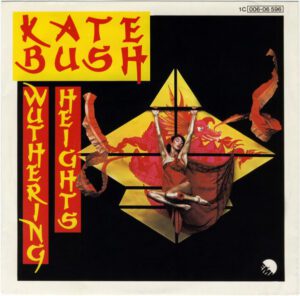
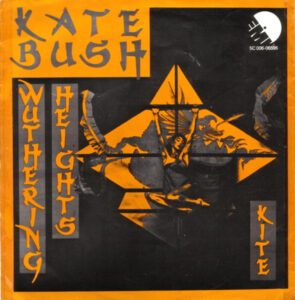
The B‑side was another Bush composition, Kite — a connection that visibly influenced the single’s visual identity.
The cover design – concept and photography
The artwork for the single mirrored the imagery used for Bush’s debut album The Kick Inside, which featured a surreal visual motif: Bush with a painted kite. That “kite” concept came from early discussions between Bush, photographer Jay Myrdal, and creative collaborators.
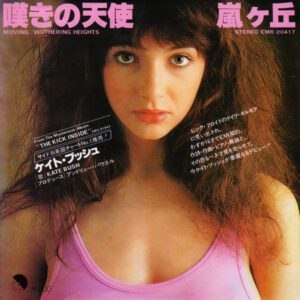
There’s also documented talk of alternative photoshoots from the era. Bush worked with photographer Gered Mankowitz on a session that included some more daring images than EMI wanted for general release. These Mankowitz outtakes, which exposed more of Bush’s upper body than intended, didn’t appear on the UK single but influenced Japanese sleeves of her releases.
Sleeve variants around the world
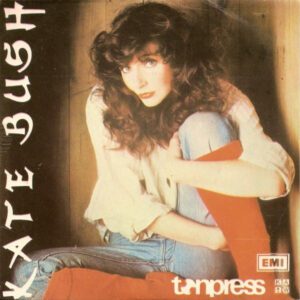
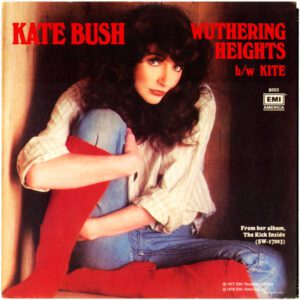
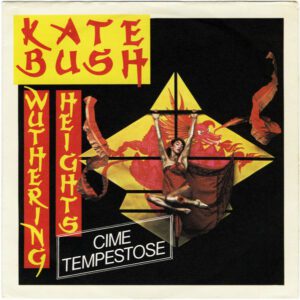
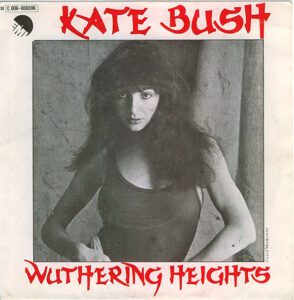
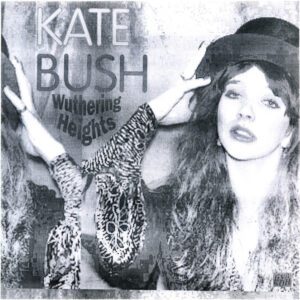
When Wuthering Heights was issued around the world in 1978, EMI didn’t produce one single global sleeve and ship it everywhere. In that era, international markets often printed sleeves locally, using whatever stock, layout formats, and imagery best matched regional production, retail conditions and taste. The result is a surprising variety of authentic commercial variants; and for a single as big as Wuthering Heights, those slight differences are exactly what collectors hunt for.
Below are some of the best‑documented commercial 7‑inch sleeves:
Tonpress – S‑120 (Poland)
EMI – 5C 006‑06596 (Netherlands)
EMI America – 8003 (USA)
EMI - 3C 006-06596 - Italy
EMI – EMR‑20417 (Japan)
EMI – 10 C 006‑006.596 (Spain)
Flexi Discs: The obscure editions
In addition to traditional 7‑inch vinyl singles, several non‑commercial flexi discs connected to Wuthering Heights also exist. These were typically produced not as general retail formats but as promotional or locally issued curios, and they now turn up mostly in collector circles:
USSR / Russia – Буд кон Д60 8867 (Blue Flexi)
A blue, single‑sided flexi disc pressing exists under the Cyrillic label Буд кон with catalogue number Д60 8867. These Eastern European flexi discs were often club‑distributed or issued in small promotional batches and not sold through standard record stores.
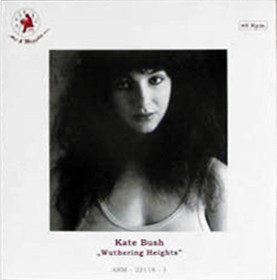
Poland – ARM‑22118‑1 (Art & Muzyka Flexi)
This 5½‑inch single‑sided flexi disc (catalogue number ARM‑22118‑1) was released in Poland under the Art & Muzyka label. It’s a legitimate physical item that appeared in limited pressings and is sought by vinyl collectors despite not being part of EMI’s main commercial rollout.
Two music videos; one iconic song
From the earliest days, Wuthering Heights had not just one but two promotional videos:
A studio version with Bush in a white dress, mist and atmospheric lighting, emphasising movement and choreography.
A second, more widely seen clip filmed on Salisbury Plain with Bush in a flowing red dress, often considered the visual most people associate with the song.
Re‑recording the vocals in 1986
Nearly a decade after Wuthering Heights first topped the charts, Bush revisited the song for her first compilation album The Whole Story (1986). For that release she recorded new lead vocals, creating what’s often credited as Wuthering Heights (New Vocal). This version also served as the B‑side to her 1986 single Experiment IV.
It wasn’t a complete overhaul of the arrangement, but the vocal re‑recording reflects Bush’s evolution as an artist and singer and it shows that even her most iconic work remained a living part of her catalogue.
Wuthering Heights – a distinctive debut
Beyond its chart success, Wuthering Heights stands out because its release history reflects how music was distributed globally in the late 1970s. Different countries, different sleeves, different materials, but one recording that cut through regardless.
Nearly fifty years on, Wuthering Heights remains one of the most distinctive debut singles ever released.