
In December 2024, music industry strategist Rob Abelow published a blog post on Where Music’s Going entitled Music’s Biggest Problems, built around a simple question posed to 35,245 people: What’s the biggest problem to solve in music?
The responses came from across the music ecosystem, including artists, managers, executives, entrepreneurs, technologists and fans. Taken together, they offer a fascinating snapshot of the industry’s anxieties, frustrations and competing priorities at a time when music is simultaneously more accessible, more global and more complicated than ever before.
Some of the answers point to long-standing structural issues and others are products of the streaming era. Several issues reflect concerns around artificial intelligence, while a few expose tensions that have existed in music for decades.
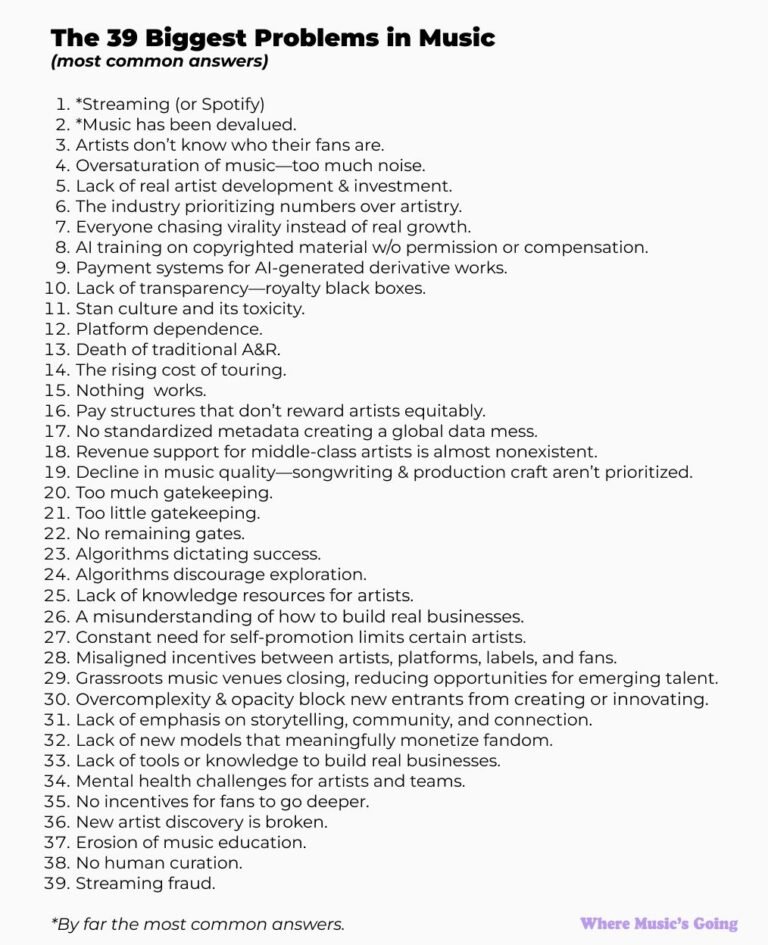
The 39 Biggest Problems In Music
The following list was published by Rob Abelow based on responses gathered from more than 35,000 participants:
- Music has been devalued *
- Streaming/Spotify *
- Artists don’t know who their fans are
- Oversaturation of music—too much noise
- Lack of real artist development & investment
- The industry prioritizes numbers over artistry
- Everyone chasing virality instead of real growth
- AI training on copyrighted material w/o permission
- Payment rails for AI-generated derivative works
- The music royalty blackbox
- Stan culture & its toxicity
- Platform dependence
- Death of traditional A&R
- The rising cost of touring
- Nothing works
- Pay structures that don’t reward artists equitably
- Shrinking revenue support for middle-class artists
- No standardised metadata creating a global data mess
- Decline in music quality, songwriting & production craft
- Too much gatekeeping
- Too few gatekeepers (& not enough gates)
- Algorithms discouraging exploration
- Algorithms dictating success
- No human curation
- Too many middlemen
- Too many platforms to navigate
- Constant need for self-promotion
- Lack of knowledge resources for artists
- A misunderstanding of how to build real businesses
- Misaligned incentives between artists, platforms, labels, and fans
- Grassroots music venues closing, reducing opportunities for emerging talent
- Overcomplexity & opacity block new entrants from creating or innovating
- Lack of emphasis on storytelling, community, and connection
- Lack of new models that meaningfully monetise fandom
- Mental health challenges for artists and teams
- No incentives for fans to go deeper
- New artist discovery is broken
- Erosion of music education
- Streaming fraud
[* By far the most common answers]
What The List Reveals About Modern Music
At first glance, the survey appears to be a catalogue of complaints but if one looks a little closer, it becomes something more useful. The list highlights where different parts of the industry believe the biggest opportunities lie.
One of the most striking aspects of the list is how frequently the responses pull in opposite directions. Some people believe there is too much gatekeeping while others think there are too few gatekeepers. Some people argue that algorithms have become overly influential, while others suggest the real problem is that there is simply too much music competing for attention.
These aren’t necessarily contradictions, they reflect the reality that music is not a single industry moving in one direction. An independent artist releasing music from a bedroom studio faces a completely different set of challenges from a major label executive, a venue owner, a songwriter or a music-tech founder.
The survey reveals how many concerns can be traced back to a handful of larger themes. Discovery, sustainability, artist development, fan engagement and transparency appear repeatedly throughout the list, even when framed in different ways.
Streaming Solved Old Problems And Created New Ones
It is impossible to read the list without noticing how often streaming appears, either directly or indirectly.
Spotify is named outright, but many of the other concerns stem from the same digital ecosystem. Questions around artist payments, platform dependence, algorithmic recommendation systems, discovery challenges and fan relationships all exist within a landscape shaped by streaming.
That does not necessarily mean streaming is the problem.
Twenty years ago, the recorded music business was in crisis. Physical sales were collapsing, piracy was rampant and many commentators believed the industry was entering a period of irreversible decline. Streaming helped reverse that trajectory and created a legal, convenient way for billions of people to access music.
The trade-off is that every solution creates new challenges. The industry solved one set of problems and inherited another.
The Missing Conversation About Fans
One of Abelow’s most compelling observations was not what appeared on the list, but what didn’t. Relatively few respondents focused on the fan experience.
That is notable because the biggest shifts in music history have usually been driven by consumer behaviour rather than industry strategy. Vinyl replaced shellac; cassettes made music portable; downloads made it instant and streaming made it frictionless.
Consumers rarely adopt new technologies because they solve industry problems. They adopt them because they improve their own experience. As a result, any conversation about the future of music that ignores fans risks missing the bigger picture.
What Fans Increasingly Want From Music
Today’s audiences have access to more music than at any point in history. Virtually every song ever recorded is available within seconds. Access is no longer the challenge but connection is.
Fans increasingly want experiences that feel personal and they want recognition, participation and opportunities to engage more deeply with the artists they support. They want communities built around shared interests and values as well as stories, interactions and experiences that extend beyond a stream or a playlist placement.
This shift is already visible across fan communities, creator platforms, Discord servers, membership programmes and artist-led experiences. The most engaged listeners are no longer satisfied with simply consuming music; they want to feel involved in the culture surrounding it.
Two Opportunities Hiding In Plain Sight
If there is a common thread running through many of the responses, it is that the industry still struggles with two fundamental challenges.
The first is creating better fan experiences centred around discovery, connection and community. Music has become easier to access than ever before, but meaningful engagement remains surprisingly difficult to build at scale.
The second is recognising that artists are effectively small businesses. Modern musicians are expected to be creators, marketers, content producers, community managers, entrepreneurs and brand builders, often simultaneously. Many still lack access to the tools, education and support systems needed to navigate those responsibilities effectively.
Addressing either challenge would help solve several issues on Abelow’s list and, of course, addressing both could reshape large parts of the industry.
The music business has never been short of problems. Every generation believes it is facing unprecedented disruption but history suggests that periods of uncertainty often create the conditions for the most significant innovation. Looking through the 39 concerns identified by Abelow’s survey, the opportunities may ultimately be more interesting than the problems themselves.