
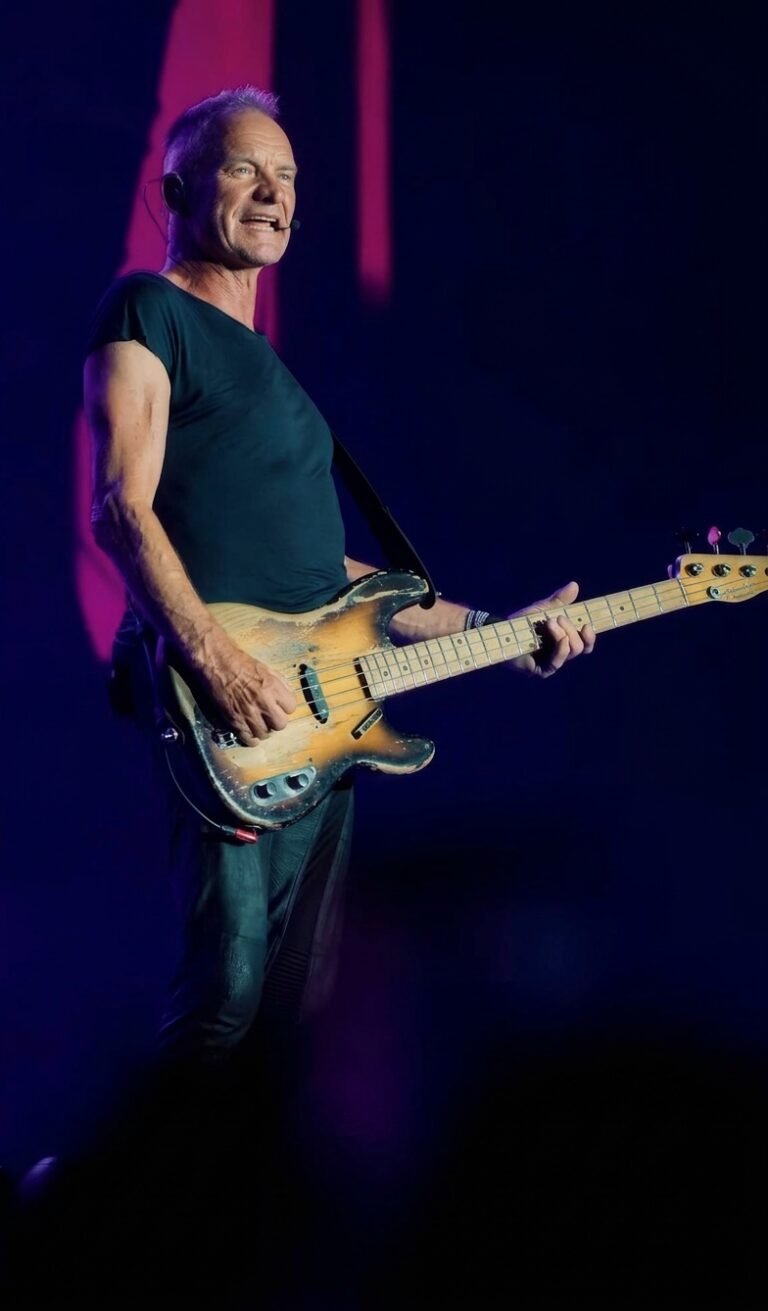
Sting has said he does not see artificial intelligence as competition for human musicians, arguing that AI cannot reproduce the lived experiences and emotions that give songwriting its meaning.
The 74-year-old former Police frontman made the comments during an appearance on BBC’s Sunday With Laura Kuenssberg on 20 September 2026, while discussing the growing role of AI in music.
Sting acknowledged that AI can produce convincing pop music, but questioned whether listeners would form the same connection with it as they do with music written and performed by people.
“I think AI can make perfectly serviceable pop music that you might hear in a railway station or a hotel lobby, and you can hear it, but would you listen to it?
“Because AI has never had its heart broken, it doesn’t have a story, it has a borrowed story, so you’re not really hearing a song.
“So, in that sense, I don’t feel any competition so far, people still want to come and see live concerts, they want to see a human being, a vulnerable human being who can make mistakes and not a machine that is perfect.”
Sting Says AI Lacks Human Experience
For Sting, the distinction between AI-generated music and human songwriting is not simply about whether technology can produce a technically convincing track.
He believes the experiences behind a song are part of what gives music its meaning. His comments echo remarks he made earlier in 2026, when he said AI had never been in love, had never had its heart broken and had no personal history or backstory.
The musician has also maintained that audiences continue to value the unpredictability of live performance, where artists can make mistakes and respond to a crowd in real time.
That does not mean Sting believes AI is harmless.
Sting Warns AI Could Affect The Labour Economy
After discussing music, Sting turned his attention to the wider economic impact of artificial intelligence.
“However, the 74-year-old rocker warned there is a “danger right now with AI potentially destroying the labour economy”.”
The Press Association reported that Sting said the risk extended beyond musicians and that “we’re all in that danger”.
His comments come as AI-generated and AI-assisted music becomes increasingly common. A recent study reported that AI was detected in around 40 per cent of music released in July 2026, adding to the wider debate around how streaming platforms, copyright and the music business should respond.
Myles Kennedy Refuses To Use AI For Songwriting
Sting is not the only established musician questioning the role of AI in songwriting.
Alter Bridge frontman Myles Kennedy recently said he will not use artificial intelligence as a songwriting tool. Speaking on SiriusXM’s Trunk Nation With Eddie Trunk on 10 September, Kennedy said he sees writing music as a creative process he does not want to shortcut.
“I will absolutely refuse to use it as a ‘writing tool’. That, to me, is… So wait, you’re gonna go to something that goes through the entire internet and takes other people’s work, and then somehow that’s going to be something you’re gonna feed off of as your … AI’s now your collaborator?”
Kennedy said he had spent the previous 10 weeks writing new material and described songwriting as one of the things he enjoys most.
“I’ve been writing for the last 10 weeks just because I’ve had some downtime, and there’s nothing I love more than writing – period. Nothing.
“So why am I gonna deny myself the joy of the great scavenger hunt? That’s the way I look at it.”
He compared songwriting to searching for something valuable through a creative process that involves solving problems, experimenting with parts and eventually finding the right combination.
“You’re trying to problem solve and find parts and navigate through all of this stuff, and then when you find it, it’s like finding gold.
“There’s nothing better, as far as just the satisfaction you get.
“So why would I cheat myself by using AI to cut to the song that’s created in an afternoon?”
Kennedy acknowledged that other musicians may find AI useful, but said it is not something he intends to adopt.
“I’m kind of old school, I guess.
“But then there are other people who are gonna say, ‘You know what? I use AI, and it helps me write, and I’m more prolific because of it.’
“And I’m, like, ‘OK, well, if that works for you, good on you.’ But I’m not joining in on that one.”
Kennedy’s comments were reported after his September 10 appearance on Trunk Nation With Eddie Trunk.
Boy George Has Used AI To Make Music
On the other side of the debate is Boy George, who has openly discussed using AI in his songwriting.
The Culture Club singer said in March that AI had changed his approach to writing and that the technology had helped him as a lyricist.
In July, he confirmed that he had used AI to create his song “We Will Dance Again”, describing his use of the technology as “AI for good”. The track was subsequently removed from Bandcamp because the platform’s policy prohibits music that is wholly or substantially generated by artificial intelligence.
That case highlights one of the practical issues surrounding AI music: artists can choose to use the technology, but platforms may have their own rules governing AI-generated material.
Sting’s View Comes As AI Music Debate Expands
Sting’s comments add another perspective to a rapidly changing music industry.
Some artists have rejected AI as a songwriting aid, while others have described it as another creative tool. Meanwhile, music platforms and industry organisations are continuing to consider how AI-generated material should be identified, licensed and monetised.
For Sting, however, the central issue remains the human experience behind a song.
His argument is that audiences are not only listening to the finished recording. They are also connecting with the person who wrote it, performed it and brought their own experiences into the music.
The technology may be capable of producing a polished track, but Sting says that does not necessarily answer the question of why someone would choose to listen.