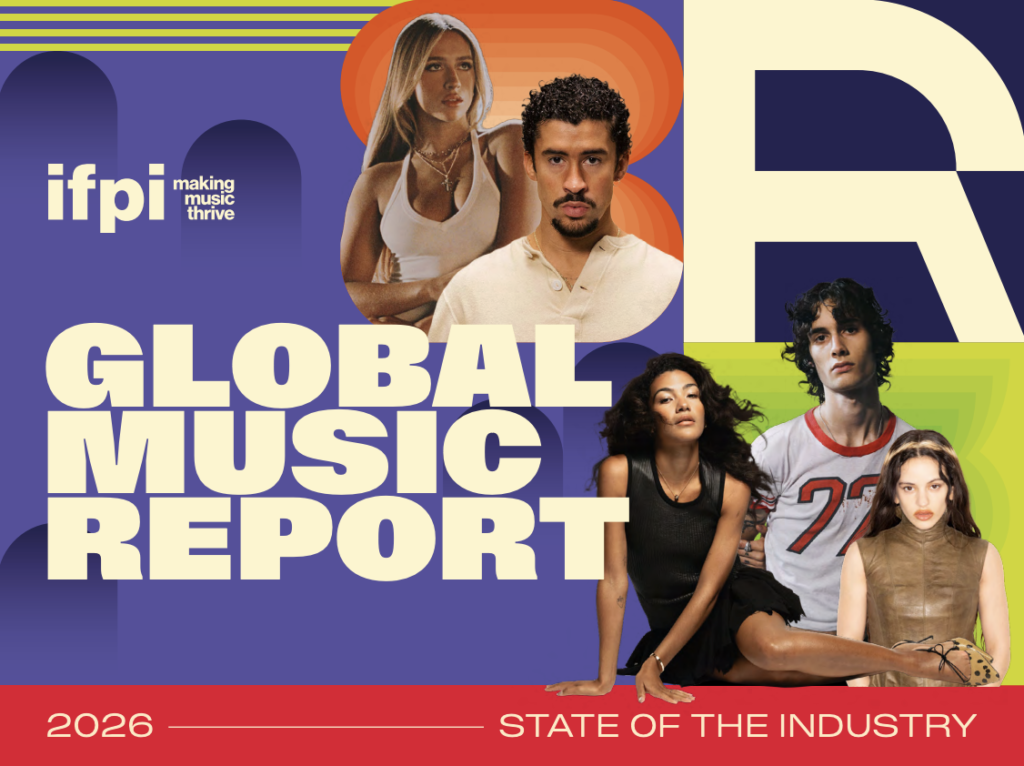
Global recorded music revenues rose 6.4% to $31.7 billion in 2025, marking an 11th consecutive year of growth, according to the latest report from IFPI.
The figures, published in the Global Music Report 2026, show an industry still expanding, although at a more measured pace as streaming markets mature.
Steady growth as streaming dominates
Streaming continues to drive the business, generating more than $22 billion and accounting for 69.6% of total global revenues.
Paid subscription streaming remains the core engine:
- Revenues up 8.8%
- Representing 52.4% of total income
- 837 million global paid subscribers
Spotify alone reported 290 million subscribers by the end of 2025, underlining the scale of the model.
After years of rapid expansion, growth has slowed slightly compared to earlier in the decade, but still represents a clear continuation of the industry’s post piracy recovery.
UK holds strong, but global competition intensifies
The United Kingdom retained its position as the third largest recorded music market globally, behind the United States and Japan.
However, the global landscape is shifting:
- China has surged to No.4, having entered the Top 10 less than a decade ago
- Brazil and Mexico continue to climb the rankings
- Competition is increasing as more regions export globally successful music
Dr Jo Twist, CEO of the BPI, said the market is now more competitive than ever, with streaming lowering barriers to entry worldwide.
AI moves to the centre of industry strategy
Artificial intelligence is now a central focus for record companies, with the report highlighting growing partnerships between rights holders and tech firms.
Lucian Grainge, chairman and CEO of Universal Music Group, recently addressed the topic at Nvidia’s GTC conference, pointing to AI as a potential driver of future growth.
The IFPI says the goal is to:
“Build an ecosystem where AI and human artistry thrive together.”
This comes amid a wave of licensing deals aimed at ensuring artists are compensated as AI tools evolve.
In a significant policy development, the UK government has stepped back from proposals that would have allowed AI companies to use copyrighted music without permission, a move welcomed by the industry.
Streaming fraud remains a growing threat
Alongside AI, the report flags streaming fraud as a major concern.
The IFPI warns that artificially inflated streams are diverting revenue away from legitimate artists and rights holders.
“Streaming fraud is theft, plain and simple,” said IFPI CEO Victoria Oakley.
She called on platforms, distributors and the wider ecosystem to take stronger action to detect and prevent fraudulent activity.
Physical formats and vinyl continue comeback
While streaming dominates, physical formats are still growing:
- Physical revenues up 8.0%
- Vinyl sales increased 13.7%, marking a 19th consecutive year of growth
Performance rights revenues also rose slightly to $2.9 billion, continuing a steady upward trend.
Every region grows, led by emerging markets
All global regions reported growth in 2025, with several posting double digit gains.
Key highlights:
- Latin America: +17.1% (fastest growing region)
- MENA: +15.2%
- Sub-Saharan Africa: +15.2%
- Asia: +10.9%, with China up 20.1%
- Europe: +5.6%
- USA & Canada: +3.5%
The Middle East and North Africa continues to stand out, with streaming accounting for 97.5% of revenues, reflecting a mobile first, digital led market.
Taylor Swift leads global artist rankings
Taylor Swift was named the biggest global artist of 2025, with her album The Life Of A Showgirl the most consumed release worldwide, according to IFPI data.
A more mature, but still expanding market
The 2025 data points to an industry that is no longer in hyper growth mode, but remains structurally strong.
Streaming is now fully embedded, emerging markets are accelerating, and AI is shaping the next phase of development.
The challenge now is balancing innovation with fair compensation, while protecting the value that has driven more than a decade of sustained growth.