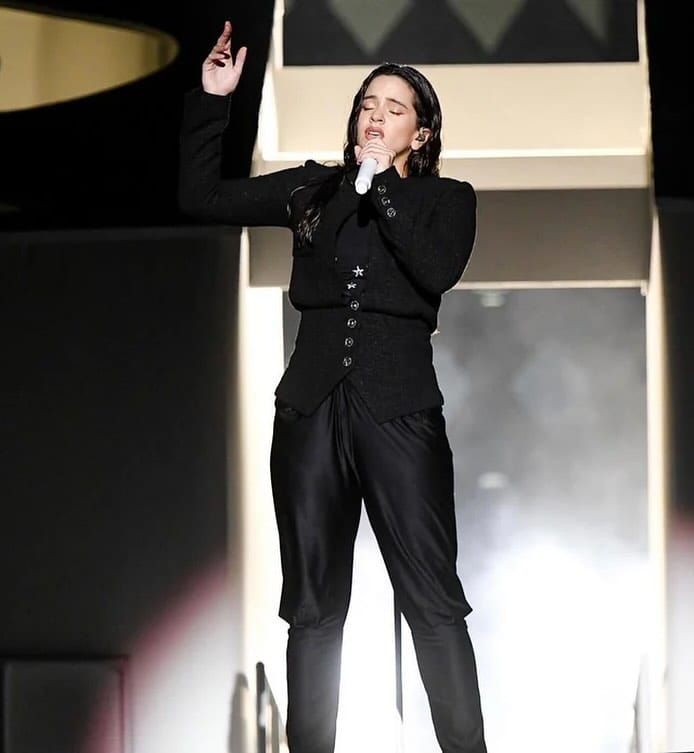
Rosalía spent nearly a year studying female saints and mystics while writing her fourth studio album, Lux, released in November. The Spanish artist researched in near isolation before recording the project, which features her singing in 14 languages and includes background vocals from Escolania de Montserrat, one of Europe’s oldest boys’ choirs.
Fifteen of the album’s 18 tracks draw directly from the lives of female saints. Each language choice reflects a specific historical or spiritual reference.
For De Madrugá, inspired by Saint Olga of Kyiv, Rosalía sings in Ukrainian. Berghain, influenced by Saint Hildegard of Bingen, is performed in German.
Rosalía on referencing saints instead of celebrities
In a recent interview with Vogue, Rosalía explained her interest in religious figures and spiritual storytelling.
“So many of these saints were nuns, and I found it so amazing to learn about their lives, learn about how they would express themselves,” she said. “They would have an experience of God, and they would explain it with words. Just speaking. It was another way of knowledge, no? Another way of understanding lo divino.”
She contrasted that approach with contemporary pop culture references.
“And I feel like nowadays a lot of people reference celebrities, and celebrities reference celebrities,” she stated. “I prefer to reference saints.”
The visual concept behind Lux
The spiritual themes extend to the album artwork. On the cover, Rosalía wears a headpiece resembling a nun’s habit designed by Maison Margiela, paired with a white garment by Alainpaul that evokes a straitjacket silhouette.
Discussing the imagery, she told Vogue:
“I was trying to find an image that would symbolise feminine spirituality,” she told the publication. “To me, this was the one that could translate how this album sounds, what this album is about, where I’m singing from, and the inspiration behind it.”
With Lux, Rosalía shifts her reference points from modern celebrity culture to centuries-old spiritual narratives, building a multilingual, research-driven body of work rooted in religious history.