
In 2015, Dutch cognitive neuroscientist Dr Jacob Jolij analysed 126 songs identified as “feel good” by UK and Republic of Ireland respondents and concluded that Queen’s Don’t Stop Me Now ranks as the happiest song ever. The research, commissioned by British electronics brand Alba, examined tempo, musical key and lyrical positivity to identify patterns in uplifting music.
The findings have been widely cited ever since, particularly around Blue Monday. Here is what the study actually did.
Where the 126-song dataset came from
Alba conducted a large-scale consumer survey asking people which songs improved their mood. Jolij was given a list of 126 unique tracks mentioned as “feel good” songs and asked to identify measurable common traits.
One limitation was methodological. The dataset only contained songs already classified as uplifting. In his blog on the subject, Jolij said:
Unfortunately, the list I got only listed feel-good songs. That’s a problem for an LMM, because you cannot fit a model if your outcome variable (feel good-song or not a feel good-song) has zero variability.
Without a comparison group of non-feel-good songs, predictive modelling was not possible. Instead, Jolij analysed averages and distributions of musical features.
How the science worked
The research started with a list of 126 popular songs spanning five decades. Jolji analysed measurable features such as:
- Tempo (Beats Per Minute / BPM)
- Musical key (major vs minor)
- Number of chords used
- Lyrical positivity (reported in press coverage)
These features were combined into a formula designed to score how uplifting a song is. According to published reports, the formula looked like:
Rating = 60 + (0.00165 × BPM – 120)^2 + (4.376 × Major) + 0.78 × nChords – (Major × nChords)
In this equation:
- BPM represents tempo,
- Major is whether the song is in a major key,
- nChords is the number of distinct chords used.
This formula wasn’t peer-reviewed science, but it was a structured attempt to quantify what many listeners feel intuitively.
The feel good music formula
Three patterns were clear across the 126 songs:
1. Faster tempo
The average tempo was significantly higher than typical pop. While the average pop song sits around 118 BPM, the feel good list clustered between 140 and 150 BPM. Faster music is consistently linked to increased energy.
2. Major key is common
Almost all were written in a major key. Only two or three songs were in a minor key. Songs in a major key scored higher in the analysis. Major keys are traditionally associated with positive emotion in music psychology.
3. More positive lyrical content
While not directly measured by a formula score, press coverage notes that lyrics with positive themes were a consistent trait.
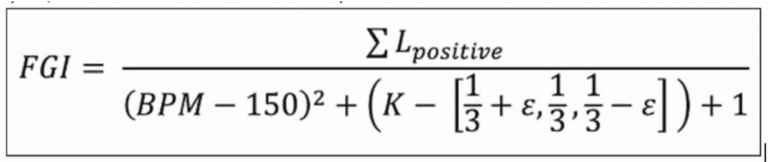
For PR purposes, Jolij was asked to express the pattern as a formula. He described it as:
The formula I came up with takes the number of positive lyrical elements in a song, and divides that by how much a song deviates from 150 BPM and from the major key.
In simplified form, the illustrative equation can be expressed as:
Feel Good Score = Positive Lyrics ÷ (|150 − BPM| + Key Deviation)
Where “Key Deviation” reflects distance from a major key centre.
Jolij was clear about its limitations:
Is this hardcore science? No, it’s data crunching.
The study was a private commission and was not published in a peer-reviewed journal. However, these trends align with broader research into music psychology, which also finds tempo and mode (major/minor) influence emotional response. For example, academic research published in Frontiers in Psychology discusses how rhythm and key affect emotional perception.
Why Don’t Stop Me Now topped the ranking
The final list was derived by selecting the most frequently mentioned song per decade from the survey. Those modal songs aligned closely with the tempo and key averages.
Queen’s 1978 single fits the profile almost exactly:
• Approximately 156 BPM
• Written in F major
• Strongly positive, high-energy lyrical theme
Originally released on Jazz, the track reached No. 9 on the UK Singles Chart. Its cultural status has grown significantly over time, becoming one of Queen’s most streamed songs worldwide.
The happiest songs list from the study
The widely reported top ten from the 126-song analysis included:
- Queen – Don’t Stop Me Now
- ABBA – Dancing Queen
- The Beach Boys – Good Vibrations
- Billy Joel – Uptown Girl
- Survivor – Eye Of The Tiger
- The Monkees – I’m A Believer
- Cyndi Lauper – Girls Just Want To Have Fun
- Bon Jovi – Livin’ On A Prayer
- Gloria Gaynor – I Will Survive
- Katrina And The Waves – Walking On Sunshine
All sit close to the 140 to 150 BPM range and are written in major keys.
For artists and producers, the takeaway is measurable rather than mystical. Faster tempo, major key tonality and positive lyrical framing consistently correlate with perceived uplift.