
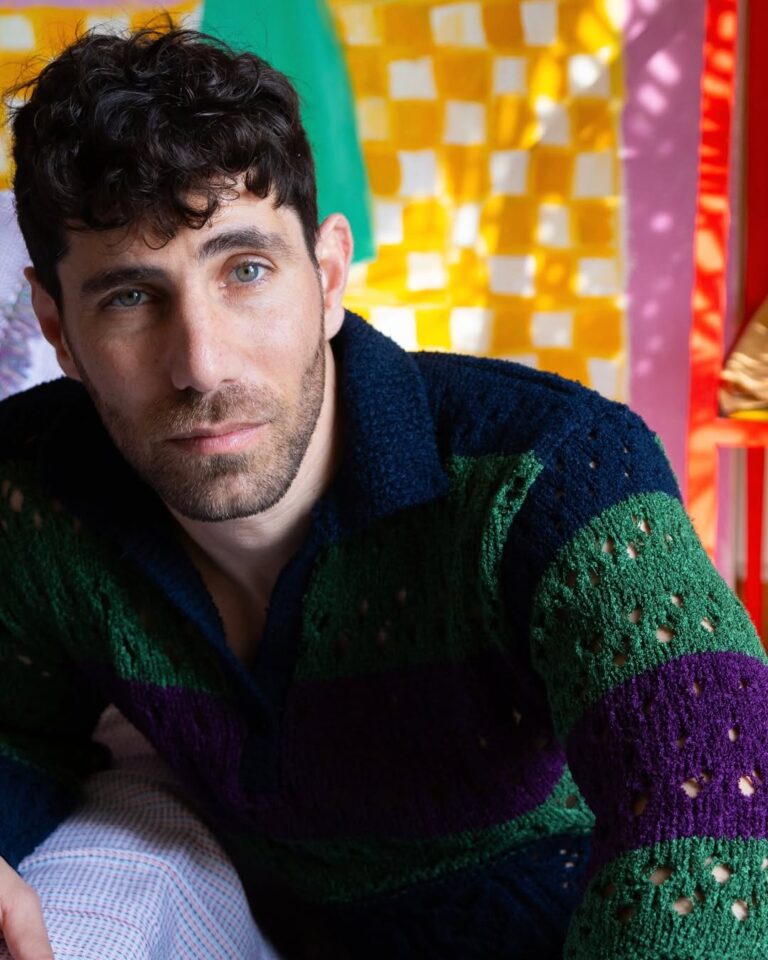
Jordanian-born artist Aziz Maraka discusses his self-created genre Razz, his route into music, and how Arabic artists are reaching global audiences. The conversation took place on Monday 27 April 2026 with Samer Jamal as part of Music Ally’s Artist Ally Summit.
Maraka, now based in Egypt, has built a career as a composer, singer and producer, known for blending Arabic music with global influences and for founding collaborative platform Bands Across Borders.
What is ‘RAZZ’ and where did it come from?
Maraka created a new genre of music – “Razz” – during his university years at the University of Arkansas in the United States, that combines Arabic music with rock and jazz influences.
“I wanted to come up with a cross-cultural idea where I present myself as an Arabic composer so I decided to combine rock and Arabic and music. I decided to borrow energy from rock music and the playfulness and the improvisation from jazz. I combined the three and I created a few songs”.
The idea was not to force genres together, but to reflect how people already live across cultures.
“We already live a very international, interactive lifestyle … so I never felt like I’m overstretching or overreaching by combining these words together. It always felt normal, it felt natural to me, and I didn’t really make a thing out of it. I just thought that I needed rock and I needed jazz in my music for me to write songs that would express my true feelings.
Nowadays we see it everywhere. I mean, now genres are interacting all the time. American musicians using Arabic samples in their music and Arab musicians using American samples and back and forth”.
While Razz helped define his early sound, Maraka no longer limits himself to the format, returning to it when it fits creatively rather than treating it as a fixed identity.
Early setbacks shaped his mindset
Despite winning a national music competition at just 12 years old, Maraka describes the experience as “traumatising” and formative in an unexpected way.
“I won a competition for best performer on keyboard and I was given a medal with a guy running on it. There wasn’t even a medal made for music in Jordan. They just made the competition, but they never even had the actual awards, you know? I won the award and I looked at it and I was extremely disappointed because I was happy to win, but I realised that Jordan is a country that doesn’t really have the infrastructure for me to ever take that path”.
That moment shifted his perspective away from validation and towards self-direction.
“That taught me, in a good sense, to never look for an award, never care for certification or testimonies. It made me very focused on what would really work for me as a musician. The awards, if anything, they were actually a turnoff for me. But it also taught me not to wait for anybody’s testimony and just focus on doing a successful job”.
His decision to pursue music professionally was reinforced later by his father, who encouraged him to study music rather than follow a conventional career path. That decision led to a scholarship in the United States, where he completed a BA degree in music composition.
The real story behind ‘Mafi Mennik’
Maraka’s breakout track Mafi Mennik has amassed more than 30 million views on YouTube, but its success came from an unconventional approach.
Before recording the track, Maraka stripped back his live performances to test whether he could connect with audiences without production or staging.
“I wasn’t so sure that am I even an artist who’s capable of entertaining people in the streets. We had one show in Alexandria, Egypt that got cancelled, so I decided to go and try and perform to my fans in Alexandria in the streets. I was really worried, letting people know that I was going to do that and then sitting there and waiting, it was such an awkward thing. What I realised, is removing all of the circumstances, removing all the shenanigans around being a star, I was testing if I could entertain people in the street and it turns out, yes, they enjoyed their time and I enjoyed my time very much”.
Mafi Mennik was recorded and filmed live on the streets of Istanbul, capturing both audio and video in real time.
“We captured the video and the audio from the street in Istanbul. We’re talking about a very busy city. We had to repeat so many times. It was the most unconventional, impractical things you could ever imagine in your life because every time a helicopter flew by us, we had to stop and repeat.
I was wondering, could I, instead of trying to make the songs look so fantastic and so magical, just capture how I feel about it and record that live, video and audio. Would it actually, would people feel those vibes?And the answer turns out for that song, at least, yes”.
The result was a raw, immediate performance that resonated far beyond traditional music video formats.
Why Arabic music is breaking through globally
Maraka sees the global rise of Arabic music as inevitable rather than surprising.
“It is really good for everybody… it’s a blessing for everyone in the Arab world that this is happening”.
He links the growth to increased global interconnectedness and cultural exchange.
“The world has been so interactive and more involved in each other’s geopolitics and so on. Already we have so much news coming out of here, so I think it was a matter of time for music to ride the wave as well and it’s lovely to see”.
He also points to platform dynamics, where even artists who do not directly go viral benefit from algorithmic discovery through related content.
Practical advice for artists using social platforms
Speaking to music creators, Maraka emphasised consistency over perfection when building a presence online.
“One of the most important things is do what you think you’re going to continue to do. So instead of trying to build these very sophisticated videos that you’re going to do once and then never do it again and be so inconsistent about existing on social media, find what’s the easiest convenient way you could capture your material.
If it’s selfie style because you don’t have any friends to shoot for you, then selfie style it is. And if you have a friend that you hang out with and you keep doing fun things that you like to do, that you like to show the world, then stick to that”.
He warned against waiting for the “perfect” launch moment.
“You’re waiting for the perfect moment… you’ll put in effort for two or three months and then let go. Or you’re going to be waiting for a year and then you’ll realise that you have a big game in front of you and a lot of work and a lot of frustration”.
Instead, he encourages artists to treat platforms as spaces for experimentation and play.
“You’re going to have to find your playful side on social media and have fun”.
A global outlook on collaboration
Looking ahead, Maraka is focused on international collaboration rather than chasing scale or status.
“I’ve been looking into, for example, offering other artists to sing my already existing songs. I have a couple of songs where I feel like it didn’t have enough by being just an Arabic song. I’m being very active this year collaborating with artists from all across the world. There’s an artist from Algeria, Lebes, we’re talking about collaborating with him”.
He is actively exploring partnerships across Europe, the UK, the US and beyond, with a focus on creative exchange rather than follower counts.
He also noted that he has yet to perform in London, despite having a strong fanbase there, alongside ambitions to reach cities across North Africa – especially Marrakesh and Casablanca, as well as regions that remain difficult to access such as Syria and Gaza.
The future of Arabic music
Asked to describe the future of Arabic music in one word, Maraka kept it simple.
“In.”