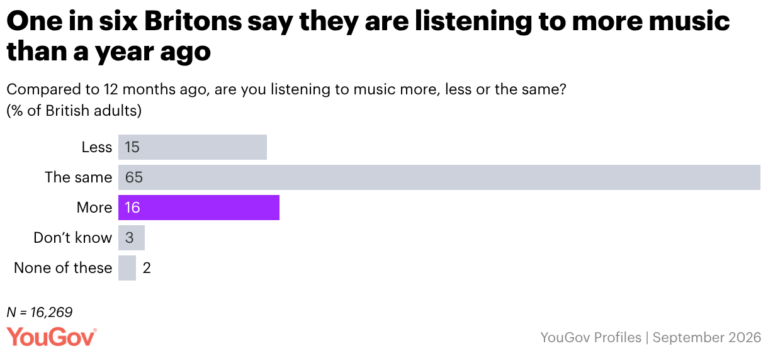
One in six British adults are listening to more music than they were a year ago, according to new YouGov research, with Gen Z driving much of the increase in music consumption.
The YouGov Profiles data, collected between September 2025 and September 2026, found that 16% of adults in Great Britain say they are listening to more music than 12 months ago. Meanwhile, 65% say their listening habits have stayed about the same, while 15% are listening to less music.
The figures also show that younger listeners are significantly more likely to have increased their music consumption, while streaming recommendations have become the leading way for this group to discover new artists and songs.
Gen Z is driving the increase in music listening
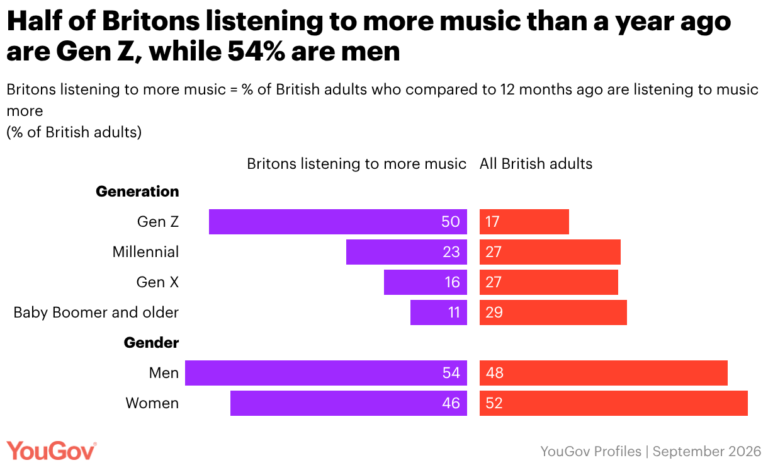
Gen Z makes up half of British adults who say they are listening to more music than a year ago.
The generation accounts for 50% of increased listeners despite representing just 17% of the adult population in Great Britain, giving Gen Z a substantial over-index compared with its share of the wider population.
Millennials account for 23% of those listening to more music, compared with 27% of British adults overall.
Older generations are less represented among people increasing their music consumption. Gen X makes up 16% of increased listeners despite accounting for 27% of the adult population, while Baby Boomers and older adults represent 11% of increased listeners compared with 29% of the population overall.
The data therefore points to a clear generational divide, with younger adults responsible for a disproportionate share of the growth in music listening.
Men are slightly more likely to be listening more
There is also a smaller gender difference among Britons who have increased their music consumption.
Men account for 54% of adults listening to more music, compared with 48% of the overall British adult population.
Women represent 46% of those listening more, despite making up 52% of British adults overall.
The difference is considerably smaller than the generational divide, but men nevertheless over-index among those increasing their listening.
Streaming recommendations lead music discovery
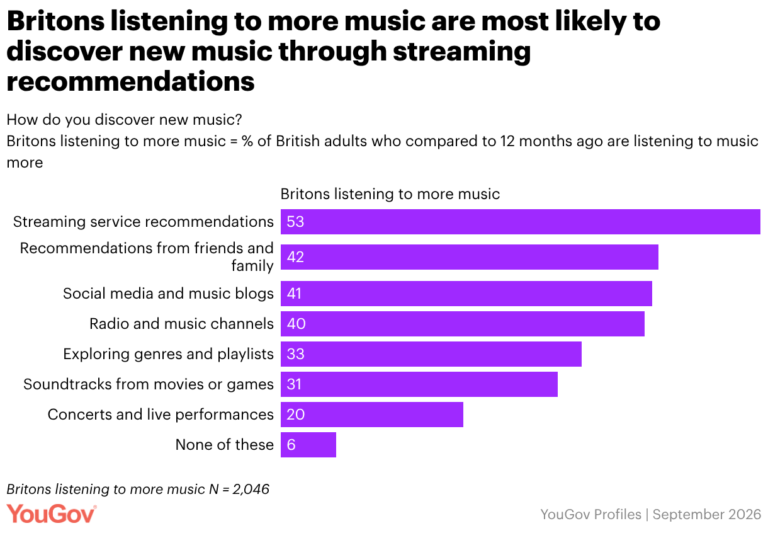
For Britons who are listening to more music, streaming services are playing the biggest role in introducing them to new artists and songs.
More than half of this group, 53%, say automated recommendations from streaming services are a source of new music discovery.
Personal recommendations from friends and family rank second at 42%, followed closely by social media and music blogs at 41%.
Radio broadcasts and TV music channels remain relevant, with 40% of increased listeners identifying them as a way they discover new music.
Other discovery routes include exploring curated playlists and new genres, cited by 33% of respondents, while 31% discover music through movie and video game soundtracks.
Live music also continues to introduce listeners to new artists, with 20% saying concerts and live performances are a source of music discovery.
84% of Britons say they like listening to music
The research also underlines the broad appeal of music in Britain.
YouGov found that 84% of adults in Great Britain describe themselves as people who like listening to music.
While the majority have not changed how much they listen over the past year, the 16% who have increased their consumption represent a significant audience, particularly among younger generations.
The findings also highlight how the ways people discover music are changing. Streaming recommendations now lead discovery among those listening more, but personal recommendations, social media, radio, playlists, soundtracks and live performances all continue to play a role.
How the data was collected
The figures come from YouGov Profiles, which uses continuously collected rolling survey data rather than a single questionnaire.
The dataset covers responses collected between September 2025 and September 2026 and is updated weekly using a 52-week rolling dataset.
The research is nationally representative of adults aged 18 and over in Great Britain, with the data weighted by age, gender, region, education and social grade.