New research from Luminate suggests that age plays a major role in how music superfans engage with artists, communities and fan culture.
The study, based on Luminate’s U.S. Music 360 data, explores how different generations behave as music fans, from attending concerts and buying merchandise to engaging in fan fiction, livestreams and online communities.
According to the findings, younger audiences dominate superfan culture, with Gen Alpha, Gen Z and Millennials making up the largest shares of highly engaged music fans.
Younger listeners dominate modern music fandom
Luminate found that music superfans “tend to be on the younger side”, with Gen Alpha accounting for 31% of the superfan audience.
Gen Z followed at 24%, while Millennials made up 25%.
Older audiences still maintain a meaningful presence, however, with Gen X representing 19% of superfans and Boomers accounting for 10%.
The report noted:
“The typical superfan is a younger, tech-savvy person who is just as likely to follow their favorite artist on the socials as they are to buy merch.”
Gen Alpha leads most superfan behaviours
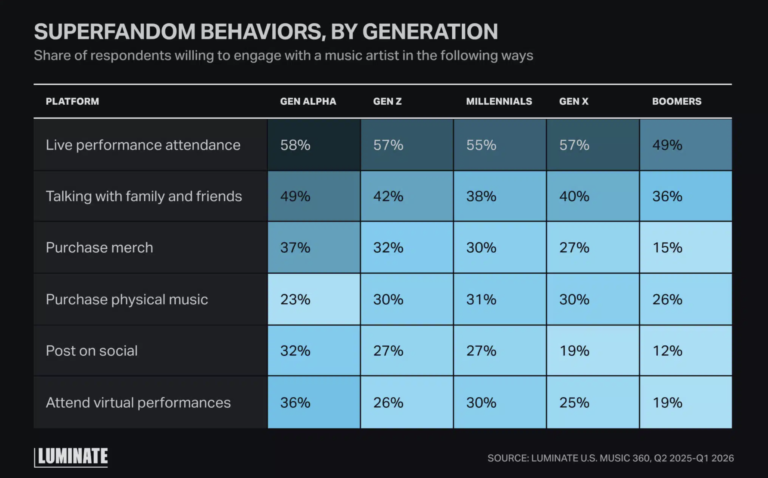
According to the study, Gen Alpha listeners, broadly defined as those born after 2010, are more likely than older generations to participate in nearly every major superfan activity tracked by Luminate.
These include:
- attending live performances
- attending virtual performances
- talking with friends and family about artists
- buying merchandise
- posting about artists on social media
Interestingly, Gen Alpha listeners were the least likely generation to buy physical music, although the gap between generations was relatively small.
Luminate’s figures showed:
- 23% of Gen Alpha listeners buy physical music
- 30% of Gen Z listeners buy physical music
- 31% of Millennials buy physical music
- 30% of Gen X listeners buy physical music
- 26% of Boomers buy physical music
Younger fans are more community-driven
The report also found that younger fans are significantly more likely to engage in fandom as a social and community-based activity.
Luminate stated:
“The generational gaps widen even more when looking at less financially motivated fan activities, with younger fans more likely to engage with one another as a community than older ones.”
That community engagement stretches beyond social media. The report suggests artists should not overlook physical fan culture and real-world meet-ups.
“In-person, community-driven events, such as fan meet-ups, may also be viable.”
Fan fiction, cosplay and livestreams remain important
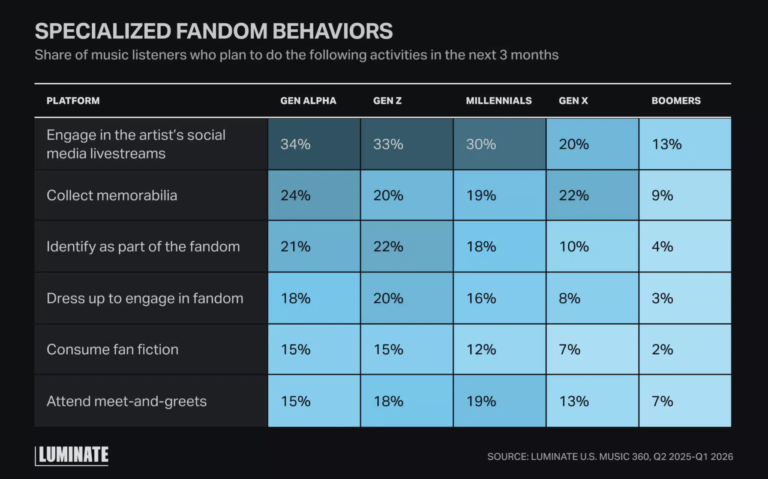
The study also examined more specialised fandom behaviours across generations.
Among the findings:
- 15% of Gen Alpha and Gen Z listeners plan to consume fan fiction within the next three months
- 18% of Gen Alpha listeners plan to “dress up to engage in fandom”
- 20% of Gen Z listeners intend to participate in fandom dress-up activities
Older generations may engage differently, but they are far from disconnected.
Luminate found that:
- 20% of Gen X music listeners intend to engage with artists through social media livestreams
- 13% of Boomer listeners also plan to use livestreams
- 22% of Gen X listeners are interested in collecting artist memorabilia, outperforming both Gen Z and Millennials in that category
The music industry’s superfan strategy continues to evolve
The concept of “superfandom” has become increasingly important across the modern music business over the past several years.
Artists, labels and platforms have increasingly focused on premium fan experiences and high-value engagement strategies, including:
- exclusive apps
- limited edition vinyl variants
- VIP experiences
- direct-to-fan memberships
- fan communities and private content hubs
Luminate’s research suggests that successful fan engagement strategies may need to become more generation-specific as audience habits continue to evolve.
The report concludes that understanding the different motivations and behaviours of superfans could help artists build stronger long-term communities, not just stronger sales.