A new US study examining stress, music and listening habits has revealed just how deeply Americans rely on playlists, favourite artists and emotionally driven songs to cope with anxiety, burnout and daily mental fatigue.
Research carried out by Tebra surveyed 1,000 adults across the United States while also analysing more than 155,000 Spotify playlist entries connected to stress relief and emotional regulation.
The findings paint a clear picture of music as an everyday coping mechanism, with listeners turning to familiar artists, reflective lyrics and mood-based playlists to manage emotional pressure.
Coldplay and Cigarettes After Sex dominate stress playlists
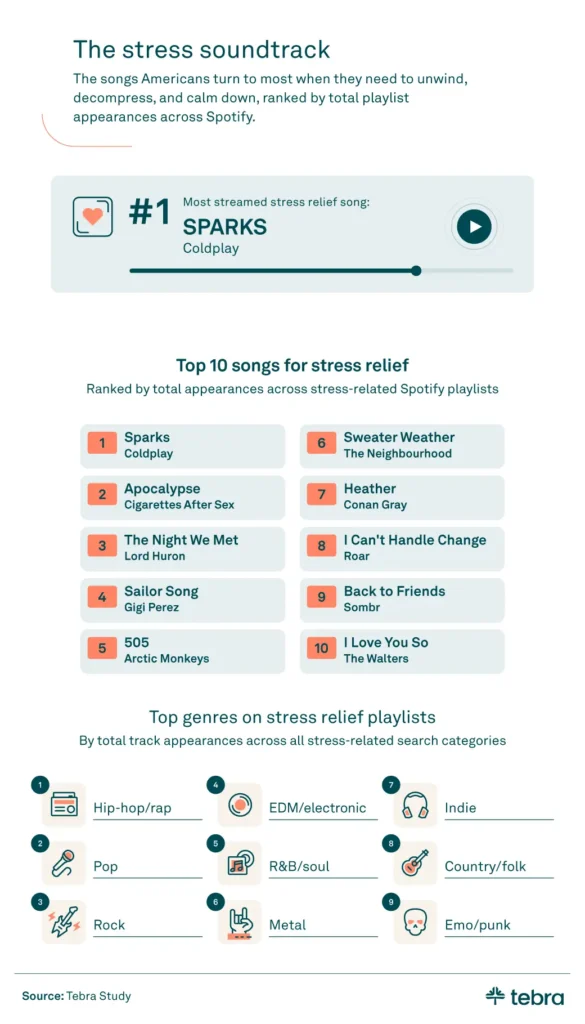
According to the Spotify playlist analysis, Sparks by Coldplay was the most commonly appearing track across stress and mental health-related playlists.
Other frequently featured songs included Apocalypse by Cigarettes After Sex and The Night We Met by Lord Huron.
Researchers noted that slower tempos and emotionally reflective lyrics appeared consistently across popular stress-relief playlists, suggesting listeners often seek music that mirrors their emotional state rather than distracts from it.
Hip-hop, pop and rock lead listening habits
The study found that Hip hop, Pop music and Rock music were the three most common genres featured on stress-related playlists.
Each genre appeared to offer listeners something different emotionally. Hip-hop and rap often provided introspective storytelling, while rock music delivered catharsis and pop offered familiarity and emotional accessibility.
Drake Taylor Swift and the Weeknd lead artist rankings
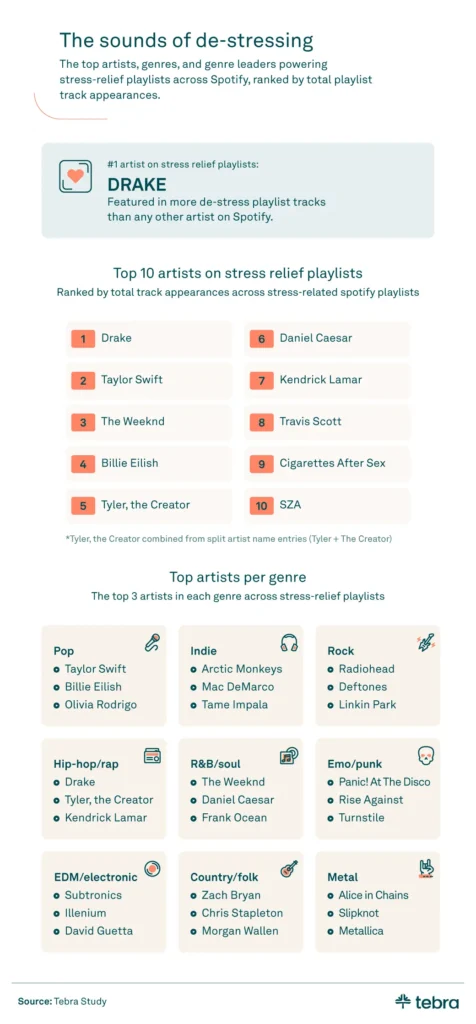
The most frequently appearing artists across stress relief playlists were Drake, Taylor Swift and The Weeknd.
Within pop-specific playlists, Taylor Swift ranked highest, followed by Billie Eilish and Olivia Rodrigo.
In hip-hop and rap, Drake led the rankings ahead of Tyler, The Creator and Kendrick Lamar.
Electronic music playlists frequently featured Subtronics, Illenium and David Guetta, while metal listeners gravitated toward Alice in Chains, Slipknot and Metallica.
Elsewhere, Zach Bryan topped country and folk playlists, while indie listeners leaned heavily toward Arctic Monkeys, Mac DeMarco and Tame Impala.
Americans increasingly use music as emotional support
The survey found that 35% of respondents considered music their number one stress-relief tool, ahead of exercise at 27% and talking to family or friends at 9%.
Nearly one-third of respondents said they listen to music daily specifically to improve their mood or reduce stress levels.
Perhaps most notably, 42% of those surveyed said they had used music as a substitute for professional mental health support at some point, highlighting how deeply music is tied to emotional self-management for many listeners.
Playlists have become personal coping systems
The research also explored how people choose what to listen to when stressed.
- 40% search for music based on their immediate mood
- 26% rely on personally curated playlists
- 13% turn to pre-made stress relief playlists on streaming platforms
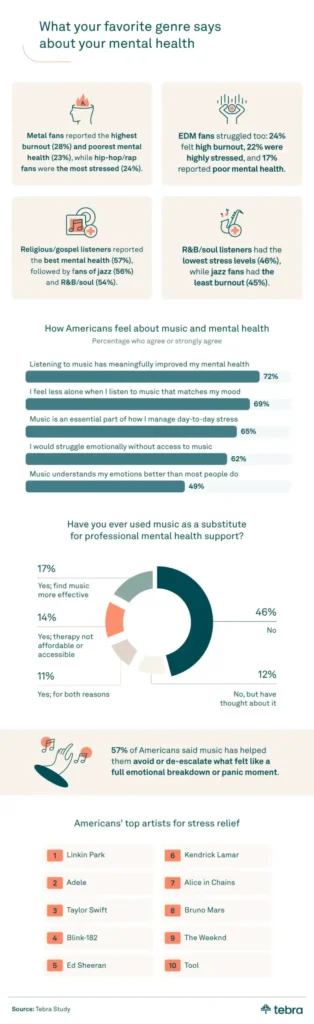
When asked directly which artists they personally associate most with stress relief, Americans most frequently named Linkin Park, Adele and Taylor Swift.
Music continues to shape mental health conversations
Researchers behind the study said the findings reflect music’s growing role as a form of emotional regulation in modern life, particularly during periods of burnout, anxiety and information overload.
The report also noted that recognising music as a coping mechanism may help healthcare professionals better understand how patients approach emotional wellbeing outside traditional therapy settings.
Study analysed more than 155000 playlist entries
Tebra’s analysis examined 560 public Spotify playlists using search terms including “anxiety”, “burnout”, “decompress”, “stress relief” and “overthinking”.
The final dataset included:
- 155,626 playlist entries
- 89,595 unique tracks
- 32,563 unique artists
Meditation audio, ambient soundscapes and non-musical therapeutic content were excluded to focus entirely on mainstream music listening habits.
The survey included respondents from across multiple generations, including Gen Z, Millennials, Gen X and Baby Boomers.
You’ll find more details of the study here.